
I became interested in the subject of women's football during my research into football on Tyneside during the Great War, when I first encountered the Munitionette teams. This prompted me to look into the earliest accounts of the game in England. I soon discovered that apart from the excellent book by David Williamson1, very little information was available, and an internet search simply returned many rehashed versions of the same, in some cases inaccurate, material. Upon consulting contemporary sources I discovered that considerably more information did exist, and decided to publish the results of my researches on this site for anyone who might be interested in a more detailed account.
I am grateful to William Cawley for details of the match played at Leek on 25th October 1895, to Steve Peart for details and photographs of the match played at High Wycombe on 11th November 1895, and to Helge Faller, Stuart Gibbs and Hugh Ross for additional details relating to several matches .
"There was an astonishing sight in the neighbourhood of the Nightingale Lane Ground, Crouch End, on Saturday afternoon. Crouch End itself rubbed its eyes and pinched its arms. The intelligent foreigner might have been excused for imagining some State function was taking place - a Drawing-Room, for example. All through the afternoon train-loads of excited people journeyed over from all parts, and the respectable array of carriages, cabs, and other vehicles marked a record in the history of Football. Yet all that this huge throng of ten thousand had gathered to see was the opening match of the British Ladies' Football Club."
The Sketch - March 27th 1895
The staging of this event was a personal triumph for a young lady with the delightfully appropriate name of Miss Nettie Honeyball. Inspired by the spirit of the age, she had founded, in late 1894, the British Ladies' Football Club. It was a time when educated women were still hoping to achieve equal rights by force of argument, and had no doubt been encouraged by the granting, in 1893, of voting rights to all adult women in New Zealand. The direct action campaign of the Women's Political and Social Union under Emmeline Pankhurst was still a decade in the future.
She placed advertisements for like-minded ladies, and succeeded in getting together a group of about 30 playing and 20 non-playing members. They were refused permission to practice at the Oval, but with the assistance of Charles de Lyons Pyke they gained access to the Nightingale Lane enclosure at Hornsey*, adjacent to the Alexandra Park racecourse. Their first practice matches here were not entirely successful, and exposed them to a fair amount of ridicule, but with twice-weekly practice and coaching from J.W. Julian, the centre-half of Tottenham Hotspur, their skills and knowledge of the game began to improve. The pitch was laid on heavy clay, and throughout the winter of 1894-95 it was never free from mud, but despite this Nettie Honeyball proudly claimed that she had never known any of the girls shirk practice. Her determination, and powers of persuasion, also resulted in Lady Florence Dixie2 agreeing to become the President of the club, on condition that "the girls should enter into the spirit of the game with heart and soul."
* The location of Nightingale Lane was sometimes described as Crouch End, and sometimes as Hornsey.
The club's activities attracted the attention of the Press from the very beginning; as early as October 1894 The Sketch published the following frivolous cartoon purporting to represent how the lady footballers would appear and behave.
Nettie Honeyball was an enigmatic character; very little is known about her, and we do not know for certain whether this was her true identity. Click here for a discussion of this intriguing question

Her motives in founding the club were set out in an interview published in The Sketch on 6th February 1895: "there is nothing of the farcical nature about the British Ladies' Football Club. I founded the association late last year, with the fixed resolve of proving to the world that women are not the 'ornamental and useless' creatures men have pictured. I must confess, my convictions on all matters, where the sexes are so widely divided, are all on the side of emancipation and I look forward to the time when ladies may sit in Parliament and have a voice in the direction of affairs, especially those which concern them most."
One major issue they had to confront was the question of deciding on a suitable dress code. Victorian London might have been ready (just) for women's football, but it was not yet ready for women in shorts. They settled on a more modest, if cumbersome, combination of voluminous blouses together with knickerbockers or a divided skirt. A fisherman's cap with a tassel completed the ensemble.
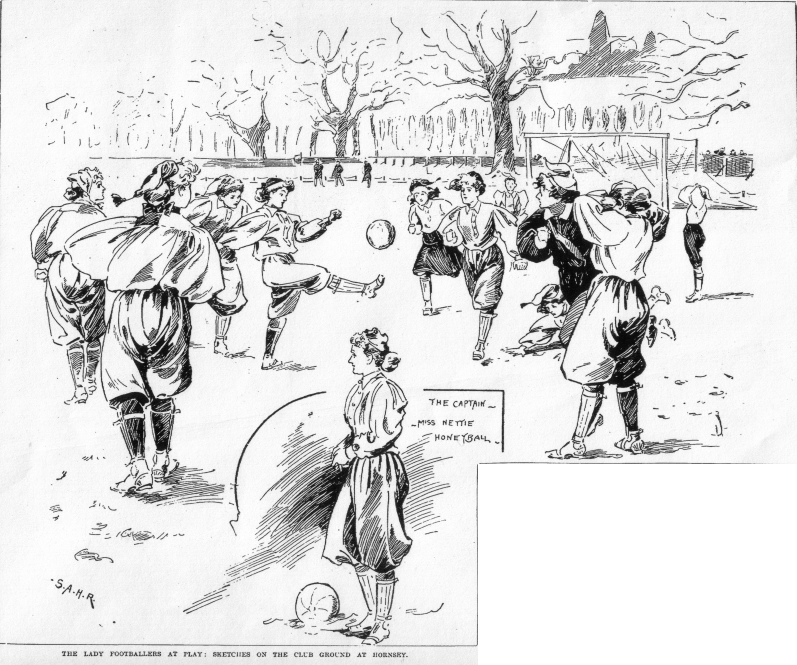
By March 1895 the club members were ready for their first public exhibition. Posters advertising the game were widely distributed3, and on the allotted day, March 23rd, ten thousand people made their way to Nightingale Lane, where they were more accustomed to see their local team take on the likes of Tottenham Hotspur. The game was preceded by a match between Crouch End and the 3rd Grenadier Guards, and the ladies did not kick off till nearly quarter to five, when their two teams, designated "North" and "South" took the field wearing all-red, and light and dark-blue outfits respectively4.
North: Mrs Graham, Misses Nettie J. Honeyball, L. Lynn, P. Smith, E. Edwards, D. Allen, Ruth Coupland, Williams, R. Thiere, B. Fenn, N. Gilbert.
South: Misses L. Clarence, Annie Hicks, Ellis, Obree, Clarke, E. Roberts, Lewis, Alice Hicks, A. F. Lewis, E. Potter, Ellis.
Lloyds Weekly Newspaper - March 31st 1895
The ladies were overwhelmed by the size of the crowd, and embarrassed at appearing in public in their knickerbockers, and confessed afterwards to having been overcome by nerves. This manifested itself in the standard of their play, about which the reporter from The Sketch was scathing:
"It would be idle to attempt any description of the play. The first few minutes were sufficient to show that football by women, if the British Ladies be taken as a criterion, is totally out of the question. A footballer requires speed, judgement, skill, and pluck. Not one of these four qualities was apparent on Saturday. For the most part, the ladies wandered aimlessly over the field at an ungraceful jog-trot. A smaller ball than usual was utilised, but the strongest among them could propel it no further than a few yards. The most elementary rules of the game were unknown, and the referee, Mr. C. Squires, spent a most agonising time."
The Sketch - March 27th 1895
This reporter did, however, have a good word for two of the players on the North team; the goalkeeper, who had travelled from Glasgow, and played under the pseudonym of "Mrs. Graham," 5 and the left winger Miss Gilbert, a diminutive person whom some of the crowd decided was a boy and nicknamed him/her "Tommy". Their efforts almost certainly contributed to the North team's winning margin of seven goals to one. The quality of the play was probably poor, but the crowd nevertheless enjoyed the spectacle, and according to another report in The Graphic, "At the close of play the teams were escorted to the pavilion and heartily cheered by a large crowd."
The following photographs of the teams appeared in The Sketch; they should not be taken too literally as the names do not correspond exactly with the teams give in Lloyds Weekly Newspaper. There are other discrepancies. For example Fenn appears in both pictures and Miss Gilbert does not look anything like a young boy.


The Crouch End match is generally held to be the first organised women's football match in England under Association rules. This is not strictly true; women's teams had existed as early as the 1880's.6 It was, however, the first game to be played in such prestigious surroundings, and witnessed by such a large crowd.
The event opened up a debate on which sports and pastimes were suitable for ladies. Lady Jeune 7, a prolific writer for London-based periodicals, proposed a practical answer; she would allow ladies to engage in all sports which permitted the wearing of the petticoat. In her opinion hunting, riding, skating, gymnastics, golf, lawn tennis, billiards, and possibly cycling, were the exercises that women "might indulge in with profit and pleasure."
The debate was the subject of comment throughout the country, and as far north as Tyneside, where an article in the Sporting Man was surprisingly sympathetic. After observing that Lady Jeune's strictures would effectively disbar women from swimming, the author continued:
"I really think the public have taken the wrong view of the lady footballers. They are either universally condemned in good set terms, or are satired unmercifully. Of course, everybody knows that they did not play good football - if, indeed, they played football at all - but who could expect it? If we were to take a similar number of young men at random, who knew nothing about the game, and give them a few days practice before asking them to perform in public, could we expect any more science than we saw in the North v. South match? True, young men would run harder and kick more strongly, but, beyond this, I cannot believe that they would show any greater knowledge of the game or skill in its execution. I don't think the lady footballer is to be snuffed out by a number of leading articles written by old men out of sympathy both with football as a a game and the aspirations of the young new women. If the lady footballer dies, she will die hard."
Sporting Man - April 4th 1895
The Jarrow Express published a more typical, and critical comment on the affair, accompanied by a rather amateurish cartoon, in which "Tommy" gets a mention:
The members of the British Ladies' Football Club have played their first match in public. We hope (severely, says The Standard) it will be their last. There will always be curiosity to see women do unwomanly things, and it is not surprising that the match was attended by a crowd numbering several thousands, very few of whom would like to have their own sisters or daughters exhibiting themselves on the football field. Some of these young persons appeared to possess only an elementary knowledge of the game and its laws, and, for the present at all events, the club is quite unlikely to attract spectators for the sake of the play. How long it will continue to attract them for reasons unconnected with sport is another matter, but it is significant that a considerable proportion of those present left the field at half-time. The laughter was easy, and the amusement was rather coarse; but these are waning delights, and we shall be surprised if a second display wins even so equivocal a success as the first.
Jarrow Express - March 29th 1895

Further north, in Scotland, it would appear that some ladies had been so inspired as to take the field themselves. On the very day that the British Ladies F.C. stepped out at Crouch End, the West Lothian Courier reported that a farmer in Bathgate had offered to let out his field - "for the benefit of lady footballers only." This prompted a reader to pen a few lines of doggerel on the subject of the "New Woman".
Following their baptism of fire at Crouch End the members of the British Ladies' Football Club took to the road, performing at a number of venues throughout the country. On 6th April 1895 they participated in a Charity Festival of Football at Preston Park in Brighton. The event was organised to raise funds for local medical charities, and despite a blustery wet afternoon, around 5,000 spectators turned up, paying 3d per head to gain admission. In addition to the ladies, the day's events also included a boys' match between Brighton and Woolwich, the Brighton Charity Cup Final between Brighton Athletic and Hove, and a rugby match between Brighton and Wickham Park. The ladies' teams were designated North and South as before, and played in the same Red and Blue colours. The teams, according to The Argus were as follows: North:- Rosa Thiere, goal; Nettie Honeyball and Lily Lynn, backs; P. Smith and F.B. Fenn, half-backs; Ruth Coupland, Edwards, Nellie Gilbert and Daisy Allen, forwards; South:- Clark, goal; Eva Roberts and M. Ellis, backs; Clarence and E. Potter, half-backs; F. Clark, Flo Hunt, A. F. Lewis, Mrs Kembell and A. J. Lewis, forwards. "Little Tommy" once again provided much of the entertainment, being more agile in the slippery mud, and showing a greater degree of skill than her teammates. Despite the South having the advantage of an extra player the North were superior, scoring their first goal within three minutes, and were 5-2 up at half-time. The second half was a nightmare for the South's goalkeeper; she delayed too long in clearing on one occasion and was charged into the net, and soon followed that up by putting the ball into her own net, to the delight of the crowd. The score at the final whistle was North 8 - South 3.
On 13th April 1895 they played at Gigg Lane, Bury, but were beset by organisational difficulties; only 14 of the 22 players turned up, and after an hour's delay, during which the 5,000 growd waited patiently, they played an eight-a-side game (two male players, Wally Holland and J.H. Edwards were persuaded to serve as goalkeepers). The teams on this occasion were; Reds:- (Mr) Holland, goal; Gilbert and Lynn, backs; Smith, half-back; Compton, Edwards, Thiere and Allen, forwards; Blues:- (Mr) Edwards, goal; Honeyball and Lewis, backs; Hunt, half back; Roberts, Graham, Lewis and Clarence, forwards.
Allen opened the scoring for the Reds, shortly followed by Edwards, but Graham clawed one back for the Blues. In the second half Thiere scored a third goal for the Reds, and Graham scored her second goal for the Blues, when, as the Bury Times put it, "Miss Lynn was unfortunate enough to mistake her own goal for her opponents and so equalised the scores; the game finished with a draw of three goals each." As in their first game, the crowd nicknamed the left winger for the Reds "Tommy," and the match report identified her as "Daisy Allen, a little sprite of four feet." The proceeds of these games were in aid of charity, and for this match at Bury the gate receipts were in excess of £100.
Easter week saw the ladies saddled with a busy schedule. On Easter Monday, 15th April 1895, they played a morning fixture at the Caversham ground in Reading. A large crowd had turned up to watch, and according to the Berkshire Chronicle, the takings eclipsed the previous record, set on the occasion of a visit by Luton Town. One hopes that the weather was fair, as the spectators were kept waiting for a full hour after the appointed time. The party was lacking four players, and they resorted to the solution previously employed by recruiting two young men to play in goal. The South had much the better of the play in the first half, but it was the North who scored the only goal of the game through centre-forward Rosa Thiere. "Tommy," and Mrs Graham were once more singled out for showing a greater degree of skill than the rest of the players. The referee for this game was a Mr. Honeyball, presumably a brother of Nettie. In the afternoon the teams played again, this time at Maidenhead, but only the score, a 4-4 draw, was reported.
The following day the club journeyed to Bristol, where they performed at Ashton Gate, the home of Bedminster FC8. As at Reading, there was not a full complement, the Reds fielding ten players and the Blues nine, and once again two young men served as goalkeepers. The reporter for the Bristol Times and Mirror was not impressed by the skills on display, observing that, "if a ball came at any speed the back was sure to miss it, and of course charging was out of the question." He made one exception though, in the case of Daisy Allen, whom he described as a plucky little youngster, "who charged her bigger companions with great courage, and showed by her play that she had mastered the rudiments of the game, which could not be said for all." On this occasion "Tommy" was given a new nickname by the Bedminster supporters - "Scottie," after their local hero Scottie Milne. Two halves of thirty minutes each were played, during which time the Reds scored twice and the Blues, whose star players were the Misses Lewis in the forward line, five times.
Other venues during this period included New Brompton (date unknown) and Walsall (17th April). A further match was scheduled for 18th April at Maze Hill, Greenwich, the home of the Royal Ordnance FC. A crowd of 3-4,000 had assembled at the ground to watch the game, but a telegram was received a few minutes after the appointed kick-off time which read; "Crouch End 5.13pm. Storm raging here. Must scratch - Honeyball." A committee meeting of the Royal Ordnance club was hastily convened, and a telegram was despatched to Nettie Honeyball seeking an explanation and a new date for the fixture. No reply had been received by noon on Friday 19th April, when a second telegram was sent, which also failed to elicit a response. According to the Kentish Mercury, Mr. G.R. Wagstaffe, the Secretary of the Club, then wired the secretary of the New Brompton Club where the ladies were performing the next day, and on learning of their arrival back in London, he confronted Nettie Honeyball at the station. She referred him to the Manager, Alfred Hewitt Smith, who was obliged by the forceful Mr Wagstaffe to sign the following undertaking in front of witnesses:
"On behalf of the British Ladies' Football Association, I Alfred Hewitt Smith, ratify the following agreement. That the British Ladies' Football Association will play a match on the ground of the Royal Ordnance Football Club, on Thursday, May 2nd, 1895, and that after the expenses of the Royal Ordnance Football Club for printing and postage, &, have been deducted from the gross gates, the remainder shall be divided in equal moieties between the Royal Ordnance Football Club and local charities."
The affair was not yet settled however; Thursday May 2nd was after the beginning of the close season, and the Football Association would not sanction the game. Yet another telegram was sent to Nettie Honeyball, this time by Mr. C.O. Pook, the club's solicitor, advising that unless the ladies played at Maze Hill before the end of April legal action would be instituted. This brought an immediate response, offering Monday, April 29th as an alternative date.
Surprisingly, this incident escaped the attention of the national newspapers, being reported only in the local press and the satirical magazine Fun, which carried a brief reference in its issue of 7th May.
The account in the Kentish Mercury contains an inconsistency, which may simply be due to an error on the part of the reporter. The BLFC was not performing at New Brompton on Saturday 20th April; they were in fact appearing at St. James's Park, Newcastle upon Tyne. The populace of the city had been eagerly awaiting their visit for some time, the Daily Chronicle having jumped the gun and announced the visit would be likely to take place on 6th April. This led to the Newcastle United office being bombarded with enquiries, and a notice was placed in the Sporting Man on 10th April to advise that tickets would not be sold in advance, but the gates would be opened early in view of the interest.
The format for the occasion was the usual; the club provided both teams, designated Reds and Blues, and the match, watched by 8,000 spectators, was staged as an exhibition event. As a warm-up to the main entertainment a match was played between two teams from the Newcastle Schools' League, and the Gateshead Borough band gave the obligatory musical interlude before the main event.
The reporter for the Sporting Man devoted most of his account of the game to a description of how the teams were dressed.
"Their costumes had been chosen with all the good taste which women are supposed to display in the arranging of style and plenty of colours. The orthodox jerseys were made the basis of the attire, but it was seen that a great deal had been left to the coquetry and taste of the wearers. In many instances they were made loose after the manner of blouses and were relieved at the edges by a little white embroidering. Some of the sleeves, too, were made extremely wide, being evidently made after a decidedly fashion-plate pattern. There was the same variety in the make of the knickers. This would seem to be a personal matter for the ladies themselves. Several of them probably more advanced in reformed dress ideas than their sisters, wore the lower garments in the ordinary football fashion. Others. probably from feelings of modesty, had made a compromise by wearing the trousers of such wide dimensions as almost to resemble an ample divided skirt. Despite this difference in the cut of the garments, however, the young women presented a pretty appearance on the field, and this was in a great measure due to the nice assortment of colours, as well as the dainty way in which the women set them off. The jerseys of one side were of dark red, relieved with white, and were a nice contrast to the dark and pale blue costumes of the other side. Perhaps it was an accident, but it was a curious fact that the wearers of the red costumes were mostly brunettes, while several of the blue-jersied players were blondes. The ladies, no doubt, knew what colour best suited them, and certain it was that they appeared to the best advantage. One or two of the players wore dainty white gloves, while in several other instances the ladies allowed their hair to hang down their backs."
Sporting Man - April 22nd 1895
The reporter had interviewed the brother of Nettie Honeyball, who was responsible for the organisation of the tour, and from him learned that the youngest player was only eleven years old. This can only have been Daisy Allen. As to the play itself, he observed, "extreme carefulness would seem to be the rule, the movements of the various players being undertaken very gingerly, reminding many of the manner in which players picked their way over a field of ice during last winter." As at Crouch End however, despite the gentleness of the play, the spectators "were in wondrous merry mood and were thoroughly delighted with the spectacle." At the close of play the Reds were victorious by four goals to three.
From Newcastle the teams travelled south again with a hectic schedule ahead of them; on Monday 22nd April they performed at Barley Bank, Darwen, Lancashire. The report in the Northern Daily Telegraph gave little information other than the facts that the crowd was in the region of 1,000, and the game was played in torrential rain. The North, in red, defeated the South by two goals to one. On Wednesday 24th April they appeared before a crowd of 3,000 at the Intake ground in Doncaster. As at Newcastle, the local press seemed more interested in the players' attire than in the game. The North team was reported as wearing red quartered shirts while the South wore blue quartered shirts. Both teams wore dark blue knickerbockers, apart from four players who donned short skirts and one, Miss Edwards, who appeared in a white shirt and straight blue knickers, which the Doncaster Gazette considered, "the simplest and most effective costume on the field." In a reference to the current fashion for tightly-laced corsets it went on to report that the players "seemed to have discarded - at least on the field - those modern abominations in the way of clothing by which women distort the graceful form which nature has endowed them with and impair their physical vigour and health."
The press were also obsessed with the sex of "Tommy." Ever since the match at Crouch End, there had been speculation that "Miss N. Gilbert," also known by the pseudonym "Daisy Allen," was actually a boy. After the match at Doncaster one of the spectators got close enough to the players to put the question, "Is the little 'un a girl?" He received the enigmatic answer, "Yes, he is." A few days later Lloyds Weekly Newspaper claimed to have put the issue beyond doubt, reporting that "Tommy" was the 13-year-old son of one of the players, whose real name was Richardson. A team photograph, taken during the club's earlier visit to Newcastle, is strong evidence that this was true, and can be viewed in the linked PDF 9. Nevertheless, "Tommy" continued to appear as Daisy Allen, and was invariably referred to as a young girl in subsequent match reports.
The teams stayed overnight in Doncaster following their appearance, and the next morning set off for Newark. The rain fell incessantly during the day, and when they took the field at Newark Town FC there were only 1,000 spectators in attendance to witness North defeat South by 3 goals to 2. The following day, Friday 26th April, they appeared before a crowd of 2,000 at Harlaxton Road, Grantham, the home ground of Grantham Rovers. The match was a tame affair, ending in a 1-1 draw. The punishing schedule continued; the next morning they set off on a long train journey to Burnley, where they were only able to field two teams of nine per side owing to injury or fatigue. They travelled straight from the station to the Turf Moor ground, and played 40 minutes each way before a crowd of 2,000 before they were able to adjourn to the Bull Hotel for something to eat.
Bramall Lane was the intended venue for a match early in May, but the F.A. Council meeting at Crystal Palace on 20th April advised Sheffield United that "it was contrary to rules that the Lady Footballers should play on their ground in May." This was probably when the Royal Ordnance Club also learned that close season matches would not be sanctioned.
The postponed affair at Greenwich finally took place on the appointed date, Monday 29th April, and resulted in a 2-2 draw. 4,000 spectators turned up to watch "Tommy" put in another star performance. Following the game the teams must have been rushed to the station for the overnight train, as they were due to commence a tour of Scotland the following day. On Tuesday 30th April they appeared before what was described as a "contemptuously good-natured crowd," of 5,000 spectators at the St Mirren ground in Paisley. The result was Reds 3, Blues 0. The next day the club performed at Murchiston Park, Falkirk, the home ground of East Stirlingshire FC. 3,000 spectators turned out to witness the South team defeat the North by two goals to one. The crowd on this occasion seemed more tolerant; the Falkirk Herald reporting that "no discourtesy was shown the 'new woman'". 24 hours later it was the turn of the capital, and a reported 7,000 spectators witnessed the Reds defeat the Blues 1-0 at Logie Green, Edinburgh, home of St Bernard's FC. The following Saturday the ladies performed at Springvale Park in Glasgow, the home of Cowlairs FC, one of the founder members of the Scottish League. A crowd of around 5,000 saw the Blues win by two goals to one.10
The progress of the tour was haphazard; from Glasgow the club travelled south again to Yorkshire, making appearances at the Sheaf House Ground, Sheffield, on 6th May, Valley Parade, Manningham, Bradford on 7th May, and Meanwood Road, Leeds on 9th May. The first match resulted in a 3-1 victory for the Blues, with their centre-forward Lewis getting a hat-trick, while the following two matches were drawn, the first 0-0 and the second 2-2. The Leeds Mercury was not impressed by the standard of the play in general, though it did have a good word for "Tommy," who scored two goals for the Reds in the third game. This latter game was also distinguished by one of the Blues, who "created quite a sensation by heading a ball in the most approved fashion."
Unbelievably, a visit to Sunderland was squeezed in between these two games; on 8th May the ladies turned out at the Blue House Field, Hendon, the home of Sunderland Nomads. The Sunderland Echo carried a report of the game, and listed the teams as follows: Reds: L. Lynn, Clark, Hudson, N. Hudson, Vernon, P. Smith (?), Daisy Allen, N. Gilbert, Edwards, R. Coupland; Blues: Mrs Graham, E. Clarke, Fenn, Oliphant, Yates, Wellburn, F. Clarke, Bird, R. Thiere, Yates. "Tommy opened the scoring," said the Echo, "with a shot that would have put any of the League champions to shame," (the League champions that year being Sunderland AFC). In the second half however the Blues put on a better show, and finished the game 2-1 ahead. Both teams had only 10 players, and a notable absentee was Nettie Honeyball.
Demonstrating the capabilities of the Victorian railway system, the club visited Exeter on 13th May, putting up at the Half Moon Hotel, and before an appreciative crowd of 1,500 the Reds defeated the Blues by three goals to two. The Western Times remarked that "financially and as a spectacle the visit of the ladies to Exeter appears to have been a decided success."
The club headed northwards once more, and on Saturday 18th May the teams performed at the Mowbray Road ground in South Shields, before a crowd of about 1,000. The weather was poor, with a freezing wind blowing across the ground, and this contributed to the low attendance. In an uneventful game the Reds defeated the Blues by three goals to one. A further match was played on the following Monday at Feethams, Darlington, but the score was not reported in either the Northern Echo or the Darlington and Stockton Times, though the former did carry the following acerbic observation:
"If it is desired to protect the Corporation property on the Victoria Embankment, the civic authorities of Darlington should see to it that a policeman is within hailing distance of the place on the occasion of football matches and other events attractive to the public. On these occasions the trees, which add so much beauty to this approach to the park, are turned into supports for impecunious individuals who balance themselves on the railings around the trees three and four at a time. They hang on by the branches, and in descending from their perches generally bring the branches with them. The presence of a man in blue might prevent such damage as was perpetrated last night on the occasion of the match between the lady footballers."
Northern Echo - May 21st 1895
Following this the club ventured into Scotland once more, staging a match at the Victoria Bridge ground in Aberdeen on 25th May. Once again "Tommy" was the focus of attention, and the crowd of 6,000 nicknamed her mother, who played at centre-forward, "Charlie". The Reds won 1-0 thanks to a goal from "Charlie". On 27th May a 1-1 draw was played at Links Park, Montrose. The Evening Telegraph commented on the goalkeeping of Mrs Graham who, it stated, was a native of Montrose. Two days later, on 29th May, they turned out at Balhousie Park, Perth, where the Blues won by 3 goals to one.
Manchester was the next stop on the tour, and 3,000 spectators assembled to watch them at Broughton Rangers FC on 1st June. The game ended in a 2-0 win for the South team, and after the match a half-mile foot race was staged between two of the players - Miss Montrose of London and Miss Taylor of Liverpool. Miss Montrose was given a three yard start (how significant would this be over a half-mile?) and "won easily," but she fainted after the race.
During the Whitsuntide holiday the ladies performed at Falcon Cliff, Douglas, Isle of Man. This was a large hotel and pleasure grounds of the type favoured by the Victorians, offering promenade concerts, dancing, and a variety of performing artists. On Whit Monday a crowd of some 2,000 were entertained by a match which was reported as a 3-2 win for the Reds in The Manx Sun, and a 3-3 draw in The Isle of Man Times. Both agreed however that the star players were "Tommy," the scorer of two goals, and the Blues' goalkeeper, who was unnamed, but was presumably "Mrs Graham." The teams played again on the following day, before another good gate, but regrettably the score was not reported in any of the local newspapers.
Returning to Liverpool, they played a nine-a-side match at the Stanley Athletic Grounds, which ended in a 2-1 win for the Reds, before continuing their westward journey. On 19th June they appeared at Cliftonville before 6,000 spectators. The report of the game which appeared the following day in The Belfast Newsletter revealed that Daisy Allen, known as "Tommy", was the daughter of Nellie Gilbert, centre-forward of the Reds team. 11 Following the game, which the Reds won 1-0 thanks to a goal from Daisy Allen, the crowd surged onto the pitch and cheered the ladies as they drove to the Shaftesbury Hotel. Once there, the referee addressed the crowd, and thanked them for the best reception the team had received in all the towns they had visited during the previous four months.
The report also stated that the team would leave for Dublin on 20th June, but their plans appear to have changed subsequently. On 21st June an advertisement appeared in The Belfast Newsletter announcing "At the request of several prominent footballers in Belfast, a Grand Match will be played between a team of the Lady Footballers and a male team of the North End Juniors at Cliftonville Grounds, Saturday June 22nd." Only 3,000 spectators turned out for this match, which was preceded by a "Reds" v "Blues" match between the ladies themselves, which the Blues won 1-0. The match against the male team was not a serious affair; the men scored twice in the first twelve minutes, and thereafter the game was reportedly played almost entirely in the ladies' half. Towards the end the ladies scored two goals themselves to equalize. Following the match a 120 yards flat race was staged for the women, which was won by Florence Clarke, with L. Yeates and Daisy Allen in second and third place respectively. A similar race over 220 yards was staged for the men's team. This game appears to have brought the club's first season to a close
Season 1895-6
When the football season resumed after the summer break it became evident that there had been a split in the ranks of the Lady Footballers. Their first appearance was on 5th September at the Royal Ordnance ground, Maze Hill, the venue which had caused them so much bother in the previous season. North, playing in red, were defeated by South, in light blue, by four goals to one. Further matches took place at Chesham, Swindon, Wembley Park, Grays (Essex), Wellingborough and Watford. The novelty seemed to be wearing off as these fixtures warranted only a few lines in the newspapers, with the exception of the match at Wembley Park, which was covered by the Illustrated Police News. This report was mostly devoted to a description of the ladies' dress and hairstyles, but it did observe that these were the "original" lady footballers, suggesting that another group was now in existence.
Confirmation of this development came in October. A photograph entitled "Mrs Graham, Captain of the Lady Footballers," was published in The Sketch in October, but there was no accompanying narrative to explain which team she was captain of. On 14th October however the Sheffield and Rotherham Independent reported that "The Original Lady Footballers as they now style themselves, are still to the fore, and are presently starring in the English Midlands. Miss Honeyball has now no connection with them, Mrs Graham, the goalkeeper, acting as secretary and general manager." In a detailed interview with the Hull Daily Mail, which appeared on 28th October, Mrs Graham confirmed this point, and added that a rival ladies' team had been established. Lady Florence Dixie had withdrawn her support, as both teams were using her name. The existence of the other organisation explains some anomalies in the match records tabulated below, where some of the overnight journeys between venues would have been well-nigh impossible. Moreover, on more than one occasion the "Original Lady Footballers" were performing simultaneously in two widely-separated places.

During this period a few match reports did give full team listings, and it is clear from them that Mrs Graham's club had retained the majority of the players from the previous season; nevertheless both clubs continued to publicise themselves as the "Original Lady Footballers." In the table below those matches involving the rival organisation to Mrs Graham's group are indicated as such. This has been deduced from the team lists (where these are available), as well as an interview given by Mrs Graham to the Luton Times and Advertiser on 22nd November 1895. In this interview she listed the venues at which her team had played since the commencement of the season.
On 16th October Mrs Graham's club played at Hastings. The Hastings and St Leonards Observer gave a detailed report of the match taking place there, together with a list of the players, thereby verifying their identity. Reporting on the game the Coventry Evening Telegraph stated that these teams would be performing at Singers Football ground on 19th October.
Also on 16th October a match involving Lady Footballers took place at Northampton, but it received only a cursory mention in the local press and the score was not reported. This was presumably the rival club, whose next appearance was at the Tomkinson Street ground in Hoole. A report of the game, which the Reds won 2-0, appeared in the Cheshire Observer on November 2nd. The date of the match was not given, but it was said to have taken place during the previous week.
The first introduction to the personalities making up the breakaway club came when they played at Leek on 25th October. The teams changed in the Red Lion Hotel, and a cheering and curious crowd assembled in the market square as the women embarked in a brake to take them to the Broad Bridge ground*. There was a great deal of enthusiasm for the match locally, and the reporter for the Leek Post and Times estimated that the attendance was around 3000, approximately 400 of whom had rushed the gate and got in without paying. The teams were not at full strength however, the Red team having 8 players while the Blues had 9, and two local men acted as goalkeepers for the afternoon. The teams were:- North (Red and White): (Mr) H. Redfern, Nellie Hudson (capt.), Nellie Clarke, Russell, Sundall, Newton, Oliphant, Ivy Hudson, Anderson; South (Blue): (Mr) Lavington, Bird, Vernon, Wilson, Hodge, Potter, Holloway, Oliver, Young, Hoferon (capt.) The star player was Ivy Hudson, a 14 year old who was encouraged on by the crowd shouting "Goo it Little Un." 12 The North seemed to dominate the play in the opening moments of the game. The match was won early in the second half when Miss Bird for the South crossed from the right for Miss Hoferon to shoot past a diving Mr Redfern in goal. To avoid confusion these ladies will be referred to subsequently as "Miss Hudson's club"
* The site, located on Abbey Green Road, is still occupied by two football pitches.
On 26th October Mrs Graham's club played at Grimsby, the Reds defeating the Blues by four goals to nil, while Miss Hudson's club played at Stafford Rangers, where the Blues defeated the Reds by 1-0. According to the Lichfield Mercury a match was scheduled to be played at Cannock two days later. Although no report of the game has been found, the proximity of Cannock to Stafford suggests that this game too involved Miss Hudson's club.
A week later, on Saturday November 2nd, Miss Hudson's club played the first of a series of games in South Wales. The opening match was played at the Harlequins ground in Cardiff. A crowd of between 7,000 and 8,000 had gathered and seemed to enjoy the occasion; not so the Lady Correspondent of the Western Mail who thought the ladies looked a "frowsy, untidy lot," with "blouses all crumpled up, as if they had been crammed into a carpet bag and left there for weeks." The game followed the usual format, and the Reds were the winners by 7 goals to 2. On the following Monday Pontypridd was the venue, the score being North 5, South 1. A match at Ynys Field, Aberdare, took place on Tuesday 5th November, but the score was not reported. A match at Neath followed on Thursday 7th, which the Reds won by 3 goals to 1. They returned to the Harlequins Ground on Friday 8th November for the final match in this mini-tour of the Principality. The opponents on this occasion were a team of local men, who had to endure the indignity of being defeated by five goals to two. A planned encounter at Llanelli did not take place owing to the local club refusing to allow their ground to be used for such a spectacle.
Not everyone was pleased with the arrival of the lady footballers in Wales; a commentator writing in the Christian Commonwealth described a match he had attended in rather un-Christian terms:
One looked in vain among the fourteen players - seven on each side - for a shapely, well-developed figure, whilst their faces were anything but refined, and their whole deportment conspicuously lacking in grace. When they stood on the ground waiting for the match to commence, the way in which some of them aped the airs and manners of men was ludicrous in the extreme. They folded their arms and strutted about after the manner of a certain type of young man, and their only redeeming point was that they seemed painfully conscious of their "double cylinders."
On 11th November 1895 Mrs Graham's club played at Loakes Park, the home of Wycombe Wanderers F.C. The teams were:- North (Reds): Lynn, Fenn, A. Lee, Brown, Yates, Smith, Dennis, F. Clarke, Gilbert, Edwardes, Aylin; South (Blues): Mrs Graham, Ashleigh, E. Clarke, Abram, J. Clarke, A. N. Other, Lee, Garbett, Rogers, Welch, Ivatt. A large crowd had assembled at the ground, and, according to the South Bucks Free Press, an even larger crowd watched for free from "Tom Burt's Hill" overlooking the ground. The North team had the better of the play from the kick off, and won by four goals to nil, all of which were ascribed to the energy of inside-left Edwardes, "a veritable Triton among the minnows," though it is not clear whether she actually scored any of them herself. A photograph record was made of the play, showing that it was very much a physical encounter. In the match programme the teams were described as the "Original Lady Footballers," and "the only genuine players, with no connection with any other teams travelling." On the same day Miss Hudson's club, purporting to be the "Original Lady Footballers" and including "Tommy" played a 0-0 draw at the Kingsholm Ground, Gloucester. Once again, two men stood in as goalkeepers, a feature of this club's games which Mrs Graham would criticise later.

Mrs Graham's club were in operation again on 20th November at the Dunstable Road ground, Luton. A full team list was published in the Luton Times and Advertiser, as follows:
South: H Graham, Rogers, Ashleigh, Abram, Hillman, Davies, Hilyard, Welsh, A Lee, Lee, Roberts
London and District: Lynn, Fenn, Hartly, Smith, Elliot, Brown, Dennis, Daisy Allen, Gilbert, Edwards, Aylin.
The score was 3-1 in favour of the South team. After the match Mrs Graham gave an interview to the press in which she revealed further details of the ongoing dispute with Miss Hudson's club. The relevant paragraphs are reproduced below, and contain the first indication that Nettie Honeyball herself was associated with the rival club who, incidentally, were playing at Chesterfield on the same day.
...An incidental mention of Miss Honeyball brought an indignant denial of any connection with that much-publicised young lady. "No, we have nothing to do with Miss Honeyball, or with Mr Smith, her manager."
"Then I suppose you are your own secretary and captain?"
"Exactly so - myself and Mrs Richardson, who is the mother of 'Tommy' - the real, original Tommy. The difference between our Ladies' Team and Miss Honeyball's is simply this - we play football, and we play full teams. With Miss Honeyball's club you get neither football, nor full teams, generally about eight a side which is absurd."
"So it was not your British Ladies' who were at Bedford the other week?"
"No, certainly not. Miss Honeyball has not been content with purloining our name and calling her club the original 'British Ladies', but she has poached some of our players after I have taken the trouble to train them."
"Was it not your team whom Mr Dick slated in the Sun recently?"
"Please don't bring that up against us. It was Miss Honeyball again, in Tufnel Park, and I remember the Sun described the girls who played as poor, emaciated-looking creatures, who ought to be brought under the notice of the Royal Society for the Prevention of Cruelty to children."
Here Mrs Richardson interposed to say that Miss Honeyball also advertised her team as including the famous 'Tommy', but the young lady had seen eighteen summers and was but a poor imitation. The youngster who attracted everyone's attention at Luton is only 14.
After their appearance at Chesterfield Miss Hudson's club (or possibly Miss Honeyball's) set of on a tour of the north west. Their first match, at Hunslet on 23rd November went unreported. On Saturday 30th November they appeared at the Athletic Ground, Milnrow Road, Rochdale. Once again two male goalkeepers were recruited. The Rochdale Observer commented that "the ladies have vastly improved in their play since they first submitted themselves to the public gaze." The game went off peacefully, with the usual banter from the crowd, and the South team, playing in Blue and White, won by 2 goals to 1. There was very little hostile criticism from the crowd - that was to come the following day when the Archdeacon of Manchester, preaching at Rochdale, said it was "a disgrace to the town that such an exhibition should be allowed to take place". This drew a riposte from a Miss Jessie Allen, claiming to be the secretary of the "British Ladies' Football Club." Her letter, which was published in the Manchester Courier on 10th December is reproduced below.
LADY FOOTBALL PLAYERS
TO THE EDITOR OF THE "MANCHESTER COURIER"
Sir:- I see by the papers that the Archdeacon of Manchester, referring to our recent visit to Rochdale, says that it is a disgrace to the town that such an exhibition should be allowed. I would respectfully ask the Archdeacon to choose his words more carefully, and not to presume on his office by offering such an insult to highly respectable young ladies. I challenge him to show the harm in females indulging in a healthy and enjoyable game, such as football, played in a proper manner, and in irreproachable attire. A recent interviewer starts his article with "Laughing, chattering, with rosy faces and plump figures, and all looking the picture of health, the two-and-twenty bloomer-wearing lady footballers skipped gaily out of the 11.20 train." &c. &c. Perhaps it is this picture of happiness and health the Archdeacon takes exception to. His beau ideal of a girl is doubtless a tiny, namby-pamby creature with her hands clasped and eyes heavenwards. We are all unanimous in saying that our "disgraceful exhibition" has vastly improved our health - which we consider it our duty to study - and it will doubtless shock the reverend gentleman to learn that Lancashire people have always given us a cordial welcome, and we are confidently looking forward to the same kind of reception on an early date. The Archdeacon says he would have got the Watch Committee to stop our exhibition at Rochdale had he known before, as it had been disallowed in other towns. I ask him to prove his words and name one place where our appearance has been prohibited. Trusting you will, in common fairness, insert this letter, and thanking you in anticipation. Yours, &c.
JESSIE ALLEN, Secretary
The British Ladies' Football Club, Ellesmere
27 Weston Park, Crouch End, London, Dec. 9 1895
The most interesting aspect of this letter is the address from which it was sent - the very same address used by Nettie Honeyball at the time of the club's first appearance. Were Jessie and Nettie one and the same person?
On 4th December the ladies performed at Coppull Lane, Wigan. They arrived in the town at mid-day and made their way to the Green Man Inn to change into their strips. The weather was appalling, the rain coming down in torrents, and the potential spectators waited in the lane outside the ground, unwilling to hand over their money until they were certain the ladies would turn out. When they did, at a few minutes past three, there was a rush for the turnstiles, and the gate was fairly reasonable considering the conditions. Somewhat predictably the Wigan Observer focussed on the players' attire, describing it as "not very becoming," and noted that the players "did not present a very elegant appearance after the match - many who had arrived with frizzy hair left with it quite straight." There was some reporting of the play however; the Reds were said to have had the best of the play, and some good shots were put in by a brunette, but were saved by the (male) goalkeeper who the reporter thought had "played rather too well considering the sort of opponents he had got." The Blues scored first, but the Reds soon equalised, and then produced a winner.
Other venues visited during this tour were Padiham, Dewsbury, St Helen's, West Manchester and Rock Ferry but no details of teams or scores were reported.
On 12th December a team featuring Mrs Graham played at Coventry FC in pouring rain against a side of young men styled the Greenwich Juniors. The result was 2-1 to the young men. A match at Cambridge Road, Colchester, on Tuesday 17th December was advertised as Mrs Graham's XI versus London and District. From this point onwards this is how Mrs Graham's matches were generally advertised. Could there have been a threat of legal action from the rival club? In the report of the game, which resulted in a 2-1 win for London and District, Mrs Graham and the ubiquitous "Tommy" were the only named players.
Two further matches were reported before the end of the year; at Nottingham on 21st December and Barnsley on 28th December. The only clue as to which club was involved is the report from the Nottingham match, which stated that eighteen young ladies participated. In view of Mrs Graham's comments to the Luton Times it is likely therefore that this was Miss Hudson's club. The club performing at Barnsley is unknown.
A match had also been scheduled to take place at Beresford Road, Liverpool, on Boxing Day 1895. A large crowd had gathered, when a telegram arrived from London cancelling the event owing to the "inability of the players to arrive on time". Fortunately no admission money had been taken or, as the Weekly Standard and Express put it, "there might have been awkward results." A ladies' football match did take place at Aston Villa on 19th February as part of a charity festival, but this appears to have been a local venture.
An interview with Nellie Hudson, captain of the "North" team appeared in the Hampshire Telegraph and Sussex Chronicle on 4th January 1896. It disclosed that she was 5 feet 7 inches tall, attributed her perfect health to playing football and that her sister (also one of the North team) originally had a weak chest but was now sound as a bell as a result of playing. She also claimed that the club was planning to travel to Paris and the United States, but this sounds very much like wishful thinking.
On 21st January 1896 a match took place at Barley Bank, Darwen between the "Lothian Lasses" and London and District, resulting in a 1-0 victory for the latter. The teams were not reported in full, but Mrs Graham was stated to have kept goal for the Lothian Lasses, and "Tommy" played for London. A match was advertised to take place on 17th February between Mrs Graham's XI and a team of men playing as "Preston Arabs." The outcome of this game, or whether it took place is unknown.
It is possible the winter weather was bad that year, as the next match involving lady footballers appears to have been on 21st March at Chelmsford. This was Miss Hudson's club, advertised as "The Original Lady Footballers." The teams were as follows:
North: JB Whitmore (male), N Hudson, Bathurst, Anderson, S Yates, Sanders, M Hudson, Baldwin, L Yates, Baldwin
South: G Lee (male), Holloway, Hodge, K Bird, Newton, Parkes, P Oliver, S Yates, F Clarke, Young.
The South team were the winners by 3-0.
It is likely that a match on March 28th at Sincil Bank, the home of Lincoln City FC, also involved Miss Hudson's club. Only 16 ladies turned out, and once again they resorted to pressing male goalkeepers into service. Very few details of the match were reported, other than the score - Reds 1, Blues 0, and the presence of "Tommy" on the pitch - presumably the fake Tommy! A match at Hoylake three days earlier was marred by one of the goalkeepers falling and breaking her leg. No further details were given ,and it is unknown therefore which club was playing at the time.
At Easter Mrs Graham's team appear to have embarked on a trip to the north. On April 3rd (Good Friday), the "Original Lady Footballers" were scheduled to appear at Middlesbrough. The announcement did not clarify which club was involved, however Mrs Graham's XI were due to meet London and District at the Victoria Ground, Stockton on the following day, therefore it is reasonable to conclude that hey had also appeared at Middlesbrough. Interestingly, a ladies' England versus France match was advertised for the Newdegate Arms Ground, Nuneaton on Easter Monday12.
Given that Mrs Graham was touring the north, the match which took place at Portsmouth Rugby Club on Easter Monday, April 6th must have involved Miss Hudson's club. A crowd of 4,000 was in attendance. Interestingly, the Hampshire Telegraph and Sussex Chronicle reported that most of the players wore short skirts, a departure from their regular uniform, though one or two "took the turf in loose knickers, which enabled them to outstrip their skirted sisters in the frequent runs after the ball." The match was described as a "tremendous struggle," which the North won by seven goals to three, largely due to the efforts of "Tommy" on the left wing.
On 13th April 1896 a match billed as "Mrs Graham's Eleven versus London and District" took place at Mowbray Road, South Shields where a large number of spectators were in attendance. The teams played in light blue and dark blue strips. To judge by the report in the Daily Chronicle, the level of football had not improved, and was extremely one-sided, so much so that the goalkeeper and full-back of one side procured an extra ball and spent part of the game practising penalties to entertain the spectators at that end. The game finished in a goalless draw.
To add to the uncertainty, the Shields Gazette reported on another match, also at Mowbray Road, on the same evening. In this game the Whites defeated the Greens by 1 goal to nil. It seems hardly credible that the reporters could confuse both the score, and the colours of the strips, and yet in both matches it was reported that the play was so one-sided that the goalkeeper and full-backs of the winning team spent part of the game playing amongst themselves with a separate ball. Without a third, independent account of affairs, it must remain a matter of conjecture as to whether one, or two games were in fact played.
The next game reported in the North East was played at Bishop Auckland on 14th April, but no details of the match or of the participating teams were given in the local press. Similar scant details were given of a match at Weymouth on 23rd April. A match which took place at the Victoria Ground, Stockton, on 25th April, resulted in only a single paragraph in the Northern Echo, however the score, North 5 South 1, was reported.
After Stockton the ladies made a final visit to Newcastle on 29th April 1896, this time playing at Jesmond. The novelty had worn off by now, and a much smaller crowd of only 300-400 witnessed the game. Organisational problems arose once more; the gates remained closed until ten minutes after the time set for kick-off, and the match was contended between teams of nine and ten players respectively. Attempts were made to persuade local girls to make up the numbers but these efforts proved unsuccessful. The Sporting Man, so supportive of the ladies on their first visit, did not think it worthwhile reporting the score, and carried a very brusque report of the event, which closed with a contemptuous, "However, we do not suppose anyone would be any the wiser or the happier if we were to attempt to deal with the proceedings in details."
Mrs Graham's club continued its journey north, heading into Scotland. A match was advertised to take place at Leith on 8th May, and on 9th May they played at Boghead Park, Bathgate. The West Lothian Courier of 16th May reported; "The largest crowd that has ever been seen on Boghead for some years turned out to witness the match. Play was not of a very scientific order, but the crowd around the ropes seemed to thoroughly enjoy the antics of the new woman. The game resulted in a win for the Whites by two goals to one."
Meanwhile, Miss Hudson's team were planning to bring ladies' football to Ireland. On 13th May 1896 an advertisement appeared in the Freemans Journal and Daily Commercial Advertiser, (Dublin). It advised readers that the British Ladies' Football Club, (President Lady Florence Dixie), would appear for the first time in Dublin at the City and Suburban Grounds13, Jones's Road, on Saturday 16th May. Admission would be 6d and 1s (2s for the "Special Grand Stand"). Unfortunately the ladies did not turn up, having missed the boat at Holyhead, but a further advertisement announced that they would appear on the following Monday and Tuesday. When they eventually did arrive it seems that they were as much of a success in Dublin as they had been in Belfast; a final advertisement appeared announcing that "Owing to their great success of the Lady Footballers" the a farewell match had been arranged for Saturday 23rd May, the opponents to be a "team of Dublin gentlemen". (The advertisement also contained the interesting information that the ladies had beaten a team of gentlemen in Cardiff on November 6th 1895.) No further details of the first two games in Dublin have so far been discovered, but in the farewell match the ladies defeated the gentlemen by 7 goals to 2.
While Miss Hudson's club were being warmly welcomed in Ireland, Mrs Graham was experiencing a reception of an entirely different kind in her native land; a game against and a Select XI (presumably men) from the District Clubs in Irvine, Ayrshire took place on or around 19th May. The affair was a disaster; Reynolds Newspaper carried the following short account on 31st May:-
"We have got the lady footballers in the North, but though they seem to be well content with us, we are not impressed by them. When they appeared at Irvine there was quite a little riot. One of the ladies got a black eye from some ruffian, the crowd of savages broke in, and the players would not go on. They were badly hustled, and had a regular struggle in order to get back to the clubhouse, Such is civilization in Scotland up to date under the auspices of Presbyterianism.
SCOTUS
Two days later these scenes were repeated when the ladies were again mobbed at Saracen Park, Possilpark, Glasgow.
When they visited Perth on 22nd May the reception was less hostile. The match took place at Balhousie Park, and was described as "miserable, from start to finish" by the Perthshire Constitutional. This was said to be their second visit to the city, and this may explain the very low attendance. The exact number of spectators was not disclosed, however the Perthshire Advertiser reported that there were only five females in the crowd. One of the players (identity not revealed) apparently took exception to a gentleman in the grandstand who persisted in shouting "foul shy." Commenting on the incident, the Perthshire Advertiser stated "it cannot be said that the reply was Parliamentary language." A large crowd assembled outside the park after the game, and as the teams drove off they were pelted with showers of sand.
The following day the teams turned out at Carolina Port, Dundee, the home of Dundee East End. The number of spectators was estimated to be no more than 300, many of whom were small boys, with only a dozen women amongst them. The Dundee Advertiser remarked that the largest towns seemed to be contributing the fewest supporters on this tour. Very little commentary was given on the play, the final observation in the brief report being that "before the match ended most of the spectators had left the field."
Another match against a team of male juniors took place at Stenhousemuir on 25th May, resulting in a 5-5 draw. The following day at Brockville Park, Falkirk, Mrs Graham's XI and London and District played a 2-2 draw. On 28th May at St Andrews they were pitted against a team of men described as "The Ancient City Athletic," they played a 7-7 draw, thanks to a penalty scored by Mrs Graham. Speaking to the St Andrews Citizen she confided that she was "far from pleased with her team's display, which was much under what they capable of." The team reportedly played at Montrose on the following evening, but a report of this game is still to be discovered. The day after they played at the Victoria Grounds, Aberdeen, with their opponents once again being a team of men selected from local junior sides. The men emerged the victors by 6 goals to 4.
A local Junior XI were once again the opposition at East End Park, Dunfermline, on 9th June, and once again the local hooligans were out in force. As the players left the pavilion after the match they were surrounded by the crowd, and had to be escorted to their hotel by four policemen, all the while while being pelted with clods of earth.
On Monday 15th June The Scotsman reported that "the lady footballers visited Broxburn, and played a game on Albion Park. Over £20 was drawn at the gate and the game ended in a win for Mrs Graham's XI by three goals to one." The name of the opposing side was not given, but it is a fair assumption that it was "London and District," as in the previous games.
A match was reported at the Hibs ground in Falkirk on 23rd June; no score was given and no details of the teams were given, but it is safe to conclude that this was Mrs Graham's organisation.
In addition to the intimidating atmosphere at some of her venues, Mrs Graham had problems off the field too. On 25th June she was sued in the Wishaw Small-Debt court by J W McMillan of Largs, for £7 of butcher meat, and by John Paton of Skelmorlie, for £1 1s. 9d. representing 29 morning's milk at 9d. per morning. Judgement was given for the plaintiffs.
Forthbank Park, Stirling, saw the ladies take on a team of men from the Bathgate area on 27th June. The ground had been rented from the local club, King's Park FC, but the club made it clear that it had nothing further to do with the proceedings. The game was described a "a pretty imitation of football" by the Stirling Sentinel and "farcical" by the Stirling Observer, and the fact that the equalising goal for the ladies in the 2-2 draw was scored by the referee lends credence to this observation.
Miss Hudson's club were still in business, or so it seemed. On 23rd June the Star reported that the British Ladies Football Club would oppose a team from the Guernsey Rangers FC on 30th July. Arrangements were in place to secure Delancey Park at St Sampson. These negotiations appear to have fallen through, as it was announced two days later that the venue would be Mr Bartlett's field at Les Vardes. Once again however their organisation let them down; on the day of the match it was reported in the Star that they had missed their train at Swansea and the match would be postponed.
It would appear that the BLFC also attempted to stage matches in Devon during July, but were thwarted by officialdom. A committee meeting of the Devon Rugby Union on 3rd July considered applications from the Bideford and Exmouth clubs, but resolved that "Under section GL of the English Laws such matches cannot be allowed; and further, the Committee strongly disapprove of any such matches being entertained."
The fortunes of Mrs Graham's club appear to have gone downhill also. On 16th July 1896 the Belfast Newsletter reported that "the lady football team is at Gourock in a destitute condition, where Mrs Graham, their captain, is down with scarlet fever." Worse was to come; in September a diminished squad set off on a tour of the West Country. A match at Wellington, Somerset, on 19th September, was described as "a complete fiasco." The rest of the tour could be described in the same way; the ladies travelled on to Exeter, but were unable to play owing to constant rain. While staying in the city in a hope of an improvement in the weather they ran up a bill of £16 which they were unable to pay. The railway company was said to have taken away some of their clothes in lieu of payment. It was reported that most of the women were from the North. An appeal to the Mayor for assistance was turned down; "if there had been but two distressed damsels he might have done something, but when it came to six of them he did not see his way to being generous." The party was bailed out temporarily by the proprietor of a local coffee shop, Mr Carnall, and on the advice of the Chief Constable the Mayor started a public subscription, which raised £6 4s 6d. The ladies were then taken to St David's station and their fares to London were paid out of the proceeds.
Three matches were reported in 1897. The first, advertised to take place at Wembley Park on 23rd January, was claimed to involve "The British Ladies Football Team" v "Wembley Park Eleven". No report of the game has been discovered. The second, at Riddings in Derbyshire, took place on 19th April and involved the "British Lady Footballers" and a team of men. The event attracted the largest crowd of the season - some 2,000 spectators turning out to watch an 8-5 defeat for the ladies in a match which was described as farcical. The third game took place at Matlock FC on 20th April; no details were reported.
On 25th October 1902, the Football Association in Council at 61 Chancery Lane passed a motion forbidding all affiliated associations to give permission for their players to participate in matches against lady football teams. This attitude to women's football at the highest level of the game's regulatory organisation would persist well into the second half of the twentieth century.
After a hiatus of 6 years, the British Ladies' Football Club briefly re-emerged in May 1903 for a match at Biggleswade against a local men's team, the Biggleswade Wesleys. Attempts were made by the Bedfordshire Football Association to prevent the game taking place, but it went ahead nevertheless, despite three of the ladies missing the train. The final score was British Ladies 3, Biggleswade Wesleys 1. Whilst not an important event in itself, it is noteworthy for the fact that Miss N Gilbert, one of the members of the team which played at Crouch End was the captain. Furthermore, a letter to the press from the club's secretary complaining about the FA's attitude was signed by Hannah Oliphant, another of the early players.14
Despite the enthusiasm of the participants, this attempt at establishing an organisational structure for women's football was short-lived. Initially it was entirely a middle-class venture, and middle-class women were not yet united in favour of the struggle for female rights. Even the feminists among them would probably have baulked at taking the field themselves, though they would certainly have given moral support to the footballers. It then seemed to degenerate into a money-raising venture, which had nothing to do with the ideal of popularising the game of football among women. In fact, it probably had an adverse effect. Another two decades were to pass before a new generation of pioneers would make a fresh effort to establish the women's game, but under the wholly different circumstances of the Great War.
© Patrick Brennan 2006, 2007, 2008, 2010, 2011, 2014
Notes
1. "Belles of the Ball" by David J Williamson; published by R & D Associates 1991, ISBN 0-9517512-0-4
2. Florence Dixie (1855-1905) was the youngest daughter of the Marquis of Queensbury. She was a female 'Indiana Jones' of her day - a poet, war correspondent, adventurer, supporter of Home Rule for Ireland and Scotland, champion of female and children's rights, and had, in 1883, survived an assassination attempt by two men disguised as women.
3. The match at Crouch End was publicised widely, and well in advance of the date, and this led to others trying to jump on the bandwagon. In Birmingham, for example, adverts appeared seeking "Girls (strong and healthy), to join the Midland Ladies' Football Association for a tour." "Healthy recreation, good pay and suitable dress provided" were some of the inducements offered. It was sufficiently attractive to entice 22 young women to make their debut at Aston on 4th March 1895. The "suitable dress" turned out to be short frocks, one team in red, the other in blue. The Reds seem to have been the winners, having scored heavily during the first half, but the report of the game suggested that most of the goals were own goals. Five hundred spectators attended the match, which appears to have been the only outing of the Midland Ladies' Football Association, as they then disappeared without trace. They did make their public debut in advance of the BLFC, but history has chosen to forget them.
4. Many references on the Internet and the printed page erroneously state that the contest was between the North and South of England. In an interview published in the Daily Graphic on March 2nd 1895 Nettie Honeyball clearly stated that the teams would represent the North of London and the South of London, and only one of the participants is recorded as having travelled from outside London.
5. In an interview given to the Dundee Courier and Argus in May 1896, "Mrs Graham" disclosed that she had been born in Montrose, but had lived for 20 of her 23 years in Lancashire. She also claimed that all the members of her team were, like her, from Lancashire. Her true identity - Miss Helen Graham Matthews, emerged in 1900. Her team allegedly still owed money to a Liverpool sports shop for some jerseys, and an over-zealous manager sent her a forged County Court notice ordering her to pay. The manager was prosecuted and bound over.
6. A group of ladies staged at least six so-called "England v Scotland" games in 1881. Several of these, including a match in Manchester, were brought to an early end by hooligans. For more details of this earlier tour click here.
7. Susan Mary Elizabeth Stewart-Mackenzie Jeune, Baroness Helier (d. 1931)
8. In 1900 Bedminster FC merged with Bristol City FC, who still play at Ashton Gate today.
9. "Is the little'un a girl?" Journal of the Northumberland and Durham Family History Society, Vol 33 Autumn 2008.
10. This was probably Springvale Park's best-attended match of the season, as Cowlairs themselves finished bottom of the Scottish second division and were not re-elected. The BLFC also had to sue the club for repayment of £15 it witheld after the match. The case was heard in the Glasgow Small Debt Court on 30th May 1895, and after a conference the parties agreed to settle for half the sum.
11. "Nellie Gilbert" was also a pseudonym; the newspaper report revealed that her real name was Mrs Richardson.
12. A match did take place as advertised, and attracted 3,000 spectators, but the report in the Coventry Evening Telegraph made no mention of the players' nationalities, and it would seem that this was another example of extravagant Victorian showmanship.
13. In 1913 the "City & Suburban Racecourse and General Amusement Grounds" was bought by the Gaelic Athletic Association and renamed Croke Park.
14. In her letter Miss Oliphant claimed to have played over 300 matches for the BLFC in the previous 10 years. If this is true, there is still a lot more research to be done!
| Date | Result | Notes |
|---|---|---|
| 1895-03-23 | North 7 South 1 | First match in public, at Crouch End, London. |
| 1895-04-06 | North 8 South 3 | Played at Preston Park, Brighton. North:- Rosa Thiere, Nettie Honeyball, Lily Lynn, P. Smith, F.B. Fenn, Ruth Coupland, Edwards, Nellie Gilbert, Daisy Allen South:- Clark, Eva Roberts, M. Ellis, Clarence, E. Potter, F. Clark, Flo Hunt, A. F. Lewis, Mrs Kembell, A. J. Lewis |
| 1895-04-13 | Reds 3 Blues 3 | Played at Gigg Lane, Bury. scorers: Allen, Edwards, Thiere for the Reds; Graham (2) and Lynn (o.g.) for the Blues Reds:- (Mr) Holland, Gilbert, Lynn, backs; Smith, half-back; Compton, Edwards, Thiere and Allen, forwards Blues:- (Mr) Edwards, goal; Honeyball and Lewis, backs; Hunt, half back; Roberts, Graham, Lewis and Clarence, forwards |
| 1895-04-15 | North 1 South 0 | Played at the Caversham ground, Reading (morning fixture) scorer: Thiere |
| North 4 South 4 | Played at Maidenhead (afternoon fixture). | |
| 1895-04-16 | Reds 2 Blues 5 | Played at Ashton Gate, Bristol. |
| 1895-04-17 | Reds 1 Blues 0 | Played at Walsall. |
| 1895-04-20 | Reds 4 Blues 3 | Played at St James's Park, Newcastle. |
| 1895-04-22 | North 2 South 1 | Played at Barley Bank, Darwen, before 1,000 spectators. |
| 1895-04-24 | North 0 South 1 | Played at the Intake ground, Doncaster, before 3,000 spectators North: L. Lynn, Daisy Allen, Williams, Gilbert, Edwards, Coupland, Fenn, Hudson, P. Smith, R. Thiere, N.J. Honeyball (capt.) South: Mrs Graham, M. Ellis, Clarke, Clarke, Farmer, Clarence, Hunt, Lewis, Lewis (the South team was not fully reported) |
| 1895-04-25 | North 3 South 2 | Played at Newark Town FC, before 1,000 spectators. |
| 1895-04-26 | North 1 South 1 | Played at Harlaxton Road, Grantham, before 2,000 spectators. |
| 1895-04-27 | Reds 1 Blues 4 | Played at Turf Moor, Burnley, before 2,000 spectators Reds: Lynn, Honeyball (capt.), M. Clarke, Fenn, Hudson, P. Smith, Welburn, Gilbert, Daisy Allen Blues: Mrs Graham, E. Roberts, Yates, Clarence, Clarke, Bird, Oliphant, Thiers, Lewis |
| 1895-04-29 | Reds 2 Blues 2 | Played at Maze Hill, Greenwich before 3,000 spectators. |
| 1895-04-30 | Reds 3 Blues 0 | Played at St Mirren, Paisley before 5-6,000 spectators. |
| 1895-05-01 | North 1 South 2 | Played at Merchiston Park, Falkirk (East Stirling FC) before 3,000 spectators. |
| 1895-05-02 | Reds 5 Blues 1 | Played at Rugby Park, Kilmarnock (Kilmarnock FC) before ? spectators. |
| 1895-05-03 | Reds 1 Blues 0 | Played at Logie Green, Edinburgh (St Bernard's FC) before 6,000 spectators. |
| 1895-05-04 | Reds 1 Blues 2 | Played at Springvale Park, Cowlairs, Glasgow before 6,000 spectators. |
| 1895-05-06 | Reds 1 Blues 3 | Played at Sheaf House Ground, Sheffield before 3,000 spectators. scorers: Lewis (3) for the Blues Reds: R. Thiere, L. Lynn, N.J. Honeyball (capt.), Fenn, P. Smith, Daisy Allen, Williams, N. Gilbert, Edwards, R. Coupland Blues: Mrs Graham, E. Roberts, M. Ellis (capt.), F. Clarke, Farmer, Clarence, Clarke, Hunt, Lewis, Lewis |
| 1895-05-07 | Reds 0 Blues 0 | Played at Valley Parade, Manningham, Bradford, before 1,600 spectators. |
| 1895-05-08 | Reds 1 Blues 2 | Played at the Blue House Field, Hendon, Sunderland, before a crowd of 4-5,000 Reds: L. Lynn, Clark, Hudson, N. Hudson, Vernon, P. Smith (?), Daisy Allen, N. Gilbert, Edwards, R. Coupland Blues: Mrs Graham, E. Clarke, Fenn, Oliphant, Yates, Wellburn, F. Clarke, Bird, R. Thiere, Yates |
| 1895-05-09 | Reds 2 Blues 2 | Played at Meanwood Road, Leeds before 1,000 spectators. |
| 1895-05-13 | Reds 3 Blues 2 | Played at the County Ground, Exeter, before 1,500 spectators. Reds: L. Lynn, N.J. Honeyball (capt), N. Clark, P. Smith, Vernon, N. Hudson, Edwards, H. Coupland, N. Gilbert, Daisy Allen Blues: Mrs Graham, E. Clarke, Fenn, H. Oliphant, Yates, Wellburn, F. Clarke, Bird, R. Thiere, Yates (10 per side) |
| 1895-05-18 | Reds 3 Blues 1 | Played at Mowbray Road, South Shields. |
| 1895-05-20 | score not reported | Played at Feethams, Darlington. |
| 1895-05-22 | Reds 1 Blues 0 | Played at the Victoria Ground, Hartlepool before 4,000 spectators. |
| 1895-05-24 | Reds 1 Blues 0 | Played at Carolina Port, Dundee before 1,000 spectators |
| 1895-05-25 | Reds 1 Blues 0 | Played at Victoria Bridge Grounds, Aberdeen before 6,000 spectators |
| 1895-05-27 | Reds 1 Blues 1 | Played at Links Park, Montrose before 2,000 spectators |
| 1895-05-29 | Reds 1 Blues 3 | Played at Balhousie Park, Perth before 3,000 spectators |
| 1895-05-30 | Reds 0 Blues 3 | Played at Gayfield, Arbroath before a "few hundred" spectators |
| 1895-06-01 | North 0 South 2 | Played at Broughton Rangers FC, Manchester, before 3,000 spectators. |
| 1895-06-03 | Reds 3 Blues 2 (3) | Played at Falcon Cliff, Douglas, I.O.M. before 2,000 spectators. (Two local newspapers disagreed on the score) |
| 1895-06-04 | score not reported | Played at Falcon Cliff, Douglas, I.O.M. |
| 1895-06-08 | Reds 1 Blues 2 | Played at the Stanley Athletic Grounds, Liverpool before 1,000 spectators. |
| 1895-06-11 | Reds 0 Blues 0 | Played at the Brookhouse Ground, Preston, before 600 -700 spectators. Advertised as the "Original Lady Footballers." (reported as teams of 8 v 9 as two players had gone home, one was sick, and no explanation for the other two) |
| 1895-06-12 | Reds 3 Blues 2 | Played at Cappielow Park, Greenock before 4,000 spectators |
| 1895-06-15 | reported as a draw | Played at Quay Meadows, Lancaster before 300 spectators |
| 1895-06-18 | North 2 South 0 | Played at The Old Public Park, Wishaw (home ground of Wishaw Thistle) before 2,000 spectators North: Lynn, N Clark, Vernon, P Smith, Hutson, Daisy Allen, Gilbert, Johnson, May Hutson South: Mrs Graham, E Clark, Yates, Cooke, Welburn, Clarke, Oliphant, L Yates, Bird |
| 1895-06-19 | Reds 1 Blues 0 | Played at Cliftonville, Belfast before 6,000 spectators. Advertised as the "Original Lady Footballers." scorer: Daisy Allen. Reds: L. Lynne, Vernon, Clark, Smith, Hudson, Coupland, Edwards, Nellie Gilbert (capt.), Daisy Allen Blues: Mrs Graham (capt.), Emma Clarke, Oliphant, Earle, Susie Yates, Wolburn, Bird, L. Yates, Clarke |
| 1895-06-22 | BLFC 2 North End Juniors 2 | Played at Cliftonville before 3,000 spectators, and reported as the club's first match against a team of men BLFC: Mrs Graham, E. Clarke, Gilbert, C. Yeates, Johnston, Flo Clarke, L. Yeates, Daisy Allen, N Hudson North End Juniors: Rowley, W Campbell, H Boyd, R Kinkead, Lythe, T Waddell, H Jefferson, C. Waddell, F McKee, H Jefferson, C. Barron |
| Reds 0 Blues 1 | Exhibition match played prior to the main event against the North End Juniors. |
| Date | Result | Notes |
|---|---|---|
| 1895-09-05 | North 1 South 4 | Played at the Royal Ordnance Ground, Maze Hill, Greenwich. Reported as being the first match of the new season. The North team played in red. |
| 1895-09-16 | Reds 2 Blues 5 | Played at the Town Ground, Chesham, before 1,000 spectators. Reported as the "Original Lady Footballers." |
| 1895-09-21 | North 5 South 3 | Played at the County Ground, Swindon, before 2,000 spectators. Reported as the "Original Lady Footballers." |
| 1895-09-26 | Reds 3 Blues 1 | Played at Wembley Park before approximately 300 spectators. |
| 1895-09-27 | score not reported | Played at Sheffield before "a few hundred spectators". |
| 1895-09-28 | Reds 0 Blues 4 | Played at the Grays Recreation Ground, Grays, Essex. |
| North 2 South 1 | Played at Leytonstone. Both goalkeepers were male, and the teams had only six players per side. | |
| 1895-10-10 | score not reported | Played at the Town Ground, Wellingborough before approximately 600 spectators. |
| 1895-10-12 | North 1 South 4 | Played at Watford. |
| 1895-10-14 | score not reported | Played at Loughborough. |
| 1895-10-16 | Reds 0 Blues 2 | Played at the Central Cricket Ground, Hastings, before 2,000 spectators. Reds: Lynn, Fenn, Lee, S. Yates, Smith, Brown, F. Clarke, Gilbert, Edwards, Aylin Blues: Mrs Graham, E. Clarke, Roberts, J. Clarke, Elliott, Rogers, Garret, Denny, L. Yates, Welsh, Welburn. |
| score not reported | Played at the County Ground, Northampton. | |
| 1895-10-17 | score not reported | Played at Bedford raising £32.19s.6d. |
| 1895-10-19 | Reds 1 Blues 1 | Played at Singers Stoke Road ground, Coventry, before 3,000 spectators. (Two men played the role of goalkeepers) |
| 1895-10-21/24 | Reds 2 Blues 0 | Played at the Tomkinson Street ground, Hoole. (exact date to be clarified) |
| 1895-10-25 | North 0 South 1 | Played at Broad Bridge, Leek North (Red and White):- (Mr) H. Redfern, Nellie Hudson (capt.), Nellie Clarke, Russell, Sundall, Newton, Oliphant, Ivy Hudson, Anderson South (Blue): (Mr) Lavington, Bird, Vernon, Wilson, Hodge, Potter, Holloway, Oliver, Young, Hoferon (capt.) |
| 1895-10-26 | Reds 4 Blues 0 | Played at Abbey Park (Grimsby FC). Reported as the "Original Lady Footballers." Mrs Graham captained the Blues, and gave an interview stating that Nettie Honeyball had no connections with the teams performing at Grimsby. |
| Reds 0 Blues 1 | Played at Stafford. Reported as the "Original Lady Footballers." | |
| 1895-10-28 | score not reported | Match scheduled to be played at Cannock. |
| 1895-10-31 | score not reported | Match scheduled to be played at Chiswick Park. |
| 1895-11-02 | Reds 7 Blues 2 | Played at the Harlequins Athletic ground, Roath Road, Cardiff before 7,000 - 8,000 spectators. |
| 1895-11-04 | North 5 South 1 | Played at Taff Vale Park, Pontypridd. |
| 1895-11-05 | Reds 2 Blues 1 | Played at Ynys Field, Aberdare, before a crowd of 500 - 600 (Merthyr Times reported only 200) |
| 1895-11-06 | Reds 1 Blues 2 | Played at the Pantscallog Ground, Dowlais |
| 1895-11-07 | Reds 3 Blues 1 | Played at the Bird In Hand field, Neath. |
| 1895-11-08 | BLFC Cardiff Men 2 | Played at the Harlequins Athletic ground, Roath Road, Cardiff. |
| 1895-11-09 | Reds 0 Blues 1 | Played at Pillgwenlly FC, Newport - said to be the last match of the Welsh Tour. |
| 1895-11-11 | North 4 South 0 | Played at Loakes Park, High Wycombe North (Reds): Lynn, Fenn, A. Lee, Brown, Yates, Smith, Dennis, F. Clarke, Gilbert, Edwardes, Aylin South (Blues): Mrs Graham, Ashleigh, E. Clarke, Abram, J. Clarke, A. N. Other, Lee, Garbett, Rogers, Welch, Ivatt. |
| Reds 3 Blues 0 | Played at the Kingsholm Ground, Gloucester. Reported as the "Original Lady Footballers." Match abandoned due to rain midway through the second half. | |
| 1895-11-13 | score not reported | Played at Portman Road, Ipswich. North (Red): Lynn, A Lee, Fenn, Smith, S Yates, Brown, Aylin, Edwards, Gilbert, F Clark, Dennis South (Blue): H Graham, E Clarke, Rogers, J Clarke, Elliott, Garbett, Lee, Welburn, L Yates, Welsh, Izatt |
| Reds 2 Blues 1 | Played at Cheltenham before "a big gate". | |
| 1895-11-14 | score not reported | Played at The Elms, Walthamstow. |
| North 1 South 0 | Played at Barbourne, Worcester before 1,000 spectators. | |
| 1895-11-18 | Reds 5 Blues 1 | Played at the Baseball Ground, Derby before 600-700 spectators. Advertised as the "Original Lady Footballers." |
| 1895-11-20 | Mrs Graham's XI 3 London and District 1 | Played at the Dunstable Road ground, Luton Mrs Graham's XI: H Graham, Rogers, Ashleigh, Abram, Hillman, Davies, Hilyard, Welsh, A Lee, Lee, Roberts London and District: Lynne, Fenn, Hartley, Smith, Elliot, Brown, Dennis, Daisy Allen, Gilbert, Edwards, Aylin. Mrs Graham gave an interview claiming that Nettie Honeyball had not been content with purloining their name and calling her club the Original British ladies, but had also poached some of her players. She also disclosed that it was Honeyball's team which had performed at Bedford recently (1895-10-17?) |
| Reds 1 Blues 2 | Played at Chesterfield Recreation Ground before "a large crowd" | |
| 1895-11-21 | score not reported | Mrs Graham's XI v London and District played at Peterborough. Advertised as the "Original Lady Footballers (Mrs Graham's Team)" |
| 1895-11-23 | score not reported | Played at Hunslet FC, Parkside, Dewsbury Road, Hunslet. |
| 1895-11-26 | score not reported | Played at Padiham, raising £4 at the gate. |
| 1895-11-30 | North 1 South 2 | Played at the Athletic Ground, Milnrow Road, Rochdale, before 1,000 spectators. |
| 1895-12-02 | score not reported | Played at Dewsbury. |
| 1895-12-04 | Reds 2 Blues 1 | Played at Coppull Lane, Wigan. |
| 1895-12-07 | North v South | Played at the Knowsley Road ground, St Helens. |
| 1895-12-11 | North 0 South 1 (half-time) | Played at the West Manchester ground (full-time score not reported). |
| 1895-12-12 | Lady Footballers 1 Greenwich Juniors 2 1 | Played at Coventry. |
| 1895-12-14 | score not reported | Played at Rock Ferry before 1,000 spectators. |
| 1895-12-17 | Mrs Graham's XI 1 London and District 2 | Played at Cambridge Road, Colchester. Advertised as the "Original Lady Footballers." |
| 1895-12-21 | score not reported | Played at Trent Bridge, Nottingham before 2,000 spectators. |
| 1895-12-28 | score not reported | Played at Barnsley Rugby Club. Reds v Blues; Blues were the winners |
| 1896-01-21 | Lothian Lasses 0 London and District 1 | Played at Barley Bank, Darwen. Mrs Graham was goalkeeper for the Lothian Lasses. |
| 1896-02-17 | Mrs Graham's XI 7 Preston Arabs 5 | Mrs Graham's XI v Preston Arabs (men) at the Brookhouse Ground, Preston. |
| 1896-03-21 | North 0 South 3 | Played at the King's Head Meadow, Chelmsford before 1,200 spectators. Advertised as the "Original Lady Footballers." North: JB Whitmore (male), N Hudson, Bathurst, Anderson, S Yates, Sanders, M Hudson, Baldwin, L Yates, Baldwin South: G Lee (male), Holloway, Hodge, K Bird, Newton, Parkes, P Oliver, S Yates, F Clarke, Young |
| 1896-03-25 | score not reported | "Original Lady Footballers" match at Hoylake - one of the goalkeepers fell and fractured her leg. |
| 1896-03-28 | North 0 South 1 | Played at Sincil Bank (Lincoln City FC) |
| 1896-04-03 | score not reported | "Original Lady Footballers" match played at Middlesbrough. |
| 1896-04-04 | score not reported | Match scheduled at Stockton between Mrs Graham's XI and London and District. |
| 1896-04-06 | North 7 South 3 | Played at North End, Portsmouth (Portsmouth Rugby Club) before 4,000 spectators |
| 1896-04-08 | Mrs Graham's XI (Whites) 2 London and District (Greens) 0 | Played at Harrogate |
| 1896-04-11 | score not reported | "British Ladies Football Club" match played at Tonbridge. |
| 1896-04-13 | Mrs Graham's XI 0 London and District 0 | Played at Mowbray Road, South Shields. Advertised as the "Original Lady Footballers (no connection with the British Ladies' Football Club)" |
| Whites 1 Greens 0 | Played at Mowbray Road, South Shields. | |
| 1896-04-14 | score not reported | Played at Bishop Auckland. |
| 1896-04-23 | score not reported | "North v South" match played at Weymouth. |
| 1896-04-25 | North 5 South 1 | "British Ladies Football Club" match played at the Victoria Ground, Stockton. |
| 1896-04-29 | score not reported | Played at Jesmond, Newcastle upon Tyne. |
| 1896-05-02 | score not reported | "British Ladies Football Club" match scheduled at Hull. |
| 1896-05-07 | Mrs Graham's XI 4 Methil Mercantile 4 | Played at the School Park, Methil, (near Kirkcaldy, Scotland) The ladies were described as the "Liverpool Lady Footballers" |
| 1896-05-08 | Mrs Graham's XI 1 London and District 1 | Played at Beechwood Park, Leith |
| 1896-05-09 | Mrs Graham's XI 2 London and District 1 | Played at Bathgate, near Edinburgh. |
| 1896-05-12 | Mrs Graham's XI 0 London and District 1 | Played at the Recreation Ground, Clackmannan Road, Alloa. |
| 1896-05-16 | Mrs Graham's XI 5 Partick Juniors 5 | Played at Partick, near Glasgow. |
| 1896-05-18 | score not reported | Mrs Graham's XI v London and District played at Tynecastle Park, Edinburgh. Advertised as the "Original Lady Footballers." |
| score not reported | "British Ladies Football Club" match played at the City and Suburban Ground, Jones's Road, Dublin. | |
| 1896-05-19 | score not reported | Match against a team of men at Irvine, Ayrshire, terminating in a riot and an attack upon the players. |
| score not reported | "British Ladies Football Club" match played at the City and Suburban Ground, Jones's Road, Dublin. | |
| 1896-05-22 | Mrs Graham's XI 2 London and District 3 | Played at Balhousie Park, Perth. |
| 1896-05-23 | Mrs Graham's XI 2 London and District 1 | Played at Carolina Port, Dundee before a crowd of about 300. |
| BLFC 7 Dublin Gentlemen 2 | Match against a team of men at
the City and Suburban Ground, Jones's Road, Dublin (one source gave the score as 5-2 to the ladies) | |
| 1896-05-25 | Mrs Graham's XI 5 Stenhousemuir Juniors 5 | Played at Ochilview Park, Stenhousemuir FC |
| 1896-05-26 | Mrs Graham's XI 2 London and District 2 | Played at Brockville Park, Falkirk. |
| 1896-05-27 | score not reported | Match played at Saracen Park, Possilpark, Glasgow which ended with a riot as spectators attacked the cabs taking the players from the ground. |
| 1896-05-28 | Mrs Graham's XI 7 Ancient City Athletic 7 | Match against a team of men before 2,000 spectators at Kinness Park, St Andrews. Mrs Graham's XI: Misses Barnstead, Welsh, Clarke, King, Goodwin, Hill, Ford, Taylor, Edwards, Lee, Mrs Graham. Ancient City Athletic: D. King, G. Thomson, Johnstone, Ripley, Mitchell, Lees, Marshall, W. King, Walker, Black, Deas One newspaper reported the score as 9-7 in favour of the ladies. |
| 1896-05-30 | Mrs Graham's XI 4 Junior Select XI 6 | Match against a team of men before 1,500 spectators at the Victoria Bridge grounds, Aberdeen. Another newspaper gave the score as 5-3 to the men |
| BLFC 5 St Columb's Court Rangers 6 | Match against a team of men at
the Brandywell Road Ground, Derry | |
| 1896-06-03 | Lady Footballers 4 Glasgow Eastern Juniors 5 | Played at Morton FC, Greenock before 2,000 spectators. After the match spectators followed the teams into the Morton clubhouse and "horseplay" resulted in the police intervening. |
| 1896-06-04 | score not reported | Exhibition match billed as "England v Ireland" played by BLFC at Moville, near Derry. |
| 1896-06-09 | Mrs Graham's XI 4 Junior XI 6 | Played at East End Park, Dunfermline. |
| 1896-06-13 | Mrs Graham's XI 3 London and District (?) 1 | Played at Albion Park, Broxburn. |
| 1896-06-20 | Mrs Graham's XI 3 Our Boys Bo'ness 3 | Played at Newton Park, Bo'ness. The London and District team missed their train, and a local boy's team stood in as the opposition. (The ladies had been advertised as "The Original Lady Footballers from Liverpool") |
| 1896-06-23 | score not reported | Played at the Hibs ground, Kilsyth, before a crowd of 200, with several hundred more watching from outside the ground. |
| 1896-06-27 | Mrs Graham's XI 2 Gentlemen's XI 2 | Played at Forthbank Park, Stirling. (The equalising goal for the ladies was scored by the referee) |
| 1896-07-03 | BLFC 2 Ormskirk Champions 3 | Played at Ormskirk. The "Ormskirk Champions" were a team of young men selected from the town's amateurs. |
| 1896-07-04 | score not reported | Played at Mossend Park, West Calder, near Livingston, West Lothian. |
| 1896-07-10 | BLFC v Ironopolis | Ladies v Men match played at the Oval, Caernavon. |
| 1896-07-14 | BLFC v Llandudno XI | Ladies v Men match played at Llandudno. |
| 1896-07-15 | BLFC v Flintshire Gentlemen | Ladies v Men match played at Flint. score not reported but Ladies won. |
| 1896-07-17 | BLFC v Carmarthen Gentlemen | Played at Morgan Arms Field, Carmarthen no record kept of the goals so match declared a draw. |
| 1896-07-18 | BLFC 3 Pembroke Dock Association 4 | Played at Ladies v Gentlemen match played at Bierspool Football Ground, Pembroke Dock. |
| 1896-07-27 | BLFC 4 Mr Jones's XI 4 | Played at the Vetch Field (Swansea FC) |
| 1896-07-29 | BLFC v Mr Jones's XI | Played at the Vetch Field (Swansea FC) The turnout at the Swansea matches was poor, and the team ran out of money, being unable to pay their fare to their next stop in Cardiff. |
| 1896-07-30 | BLFC v Guernsey Rangers | Match scheduled against a team of men, to be played at Les Vardes, Guernsey. Advertised as the "British Ladies' Football Club. (The BLFC is the original ladies' football club formed in London two seasons ago)." The ladies however missed their train, and the game was cancelled. |
| Date | Result | Notes |
|---|---|---|
| 1896-08-05 | BLFC v The Susquehannahs | Ladies v men match played at the Cardiff Exhibition Bicycle Track to the accompaniment of music |
| 1896-08-06 | BLFC v The Susquehannahs | Ladies v men matches (2) played at the Cardiff Exhibition Bicycle Track to the accompaniment of music |
| 1896-08-08 | BLFC 7 Cadoxton 1 | Ladies v men match played at the Witchill Grounds, Cadoxton, Wales. |
| 1896-08-24 | BLFC 5 Treherbert Gentlemen 3 | Ladies v men match played at Treherbert. |
| 1896-08-?? | BLFC 2 Mountain Ash 3 | Ladies v men match played at Mountain Ash, Rhondda Valley, Wales. |
| 1896-09-12 | BLFC 5 Falmouth 4 | Ladies v men game played at the Recreation Ground, Falmouth Only 7 ladies turned up and four local men made up the side |
| BLFC 3 Treharris Rangers 4 | Ladies v men match played at Berthllwyd before 500 spectators | |
| 1896-09-19 | Lady Footballers 2 Wellington FC 2 | Played at Wellington, Somerset. |
| 1896-09-?? | score not reported | BLFC match reportedly took place at Newton Abbot. Exact date unknown |
| 1896-09-?? | score not reported | BLFC match reportedly took place at Trowbridge. Exact date unknown |
| 1896-09-23 | BLFC 3 Exeter Artillery 5 | Ladies v men match at the County Ground, Exeter. |
| 1896-10-24 | BLFC 2 Ferndale 3 | Ladies v men match played at Ferndale, Rhondda Valley, Wales. |
| 1896-11-05 | BLFC 3 Newmarket 3 | Ladies v men(?) match played at Newmarket before 600 spectators. |
| 1896-11-07 | score not reported | Match against a "VAC & AC" team at the Athletic Grounds, Aylesbury. Reported as the "Original Lady Footballers." |
| 1896-11-14 | score not reported | Ladies v Men match scheduled at Cowbridge, Wales. At the last minute the use of the Cowbridge FC ground was refused, and the match took place at a field belonging to the Bear Hotel. |
| 1897-01-23 | score not reported | Match between British Ladies Football Club v Wembley Park Eleven advertised. |
| 1897-04-03 | Ladies 3 Gentlemen 2 | Played at the Recreation Ground, Romford before 400 spectators. Little more than 30 minutes were played. Newspaper reports referred to the "English Ladies Football Team." |
| 1897-04-19 | BLFC 5 Gentlemen 8 | Played at Riddings, Derbyshire before 2,000 spectators. |
| 1897-04-20 | score not reported | Ladies v men game played at Matlock FC, resulting in the biggest takings of the season. |
| Date | Result | Notes |
|---|---|---|
| 1902-05-19 | BLFC 3 Gentlemen 2 | Played at Redhill as part of the Whit Monday Gala. |
| 1903-04-14 | score not reported | BLFC v Erith Town (men) match played at Erith. |
| 1903-05-02 | BLFC 3 Biggleswade Wesleys 1 | Ladies v men match played at Fairfield, Biggleswade. Miss Gilbert was captain of the ladies' team, and Miss H Oliphant the secretary. |
This list is still being added to, so if you find the subject matter of interest please visit again.
© Patrick Brennan 2006, 2007, 2008, 2009, 2014, 2015
