Nettie Honeyball
Return
I am grateful to Peter Seddon for his assistance in (I believe) finally solving the mystery of Nettie Honeyball's identity. Peter is a well-known writer and sports historian. He has published a number of authoritative football books, and is an acknowledged specialist on the Victorian and Edwardian game.
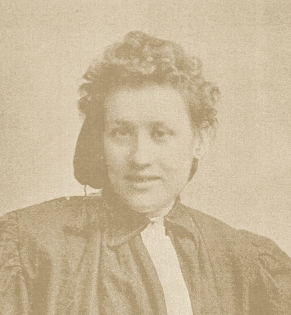 Although the exploits of the British Ladies' Football Club were regularly reported in the national and local press during 1895, surprisingly little personal information was given about the club's founder, Nettie Honeyball. The few facts which were reported are summarised below:
- Her name was invariably reported as "Nettie Honeyball" or "Nettie J. Honeyball."
- At the time of the club's first public appearance in 1895 her address was given as "Ellesmere", 27 Weston Park, Crouch End, N. London.
- She reportedly had a brother, who accompanied the ladies on their UK tour and acted as an organiser and occasional spokesman.
- Photographs of her show a young woman aged about 24-30, of above average height, and (as she revealed in an interview with the Daily Graphic), scaling eleven stones. There is the suspicion of a defect in her left eye - possibly even an artificial eye.
Sadly, even this limited information appears to be unreliable. The information concerning her brother comes from the Sporting Man (Newcastle upon Tyne) of 22nd April 1895. It describes him as an "enterprising young man, who conducts the tours of the ladies." However, the following week the Kentish Mercury, in the aftermath of the Greenwich fiasco, disclosed that the manager of the club was named Alfred Hewitt Smith.
Efforts to learn more about her from the usual genealogical sources have proved frustrating. Nettie is clearly a diminutive; probably derived from Annette, Antoinette, Janet, Jeanette, and such like, or possibly Henrietta. A promising and tantalising lead is found in the 1891 census, where "Janetta Honeyball," age 21, is recorded as boarding at 155-159 Lambeth Walk. This was the grocery shop of Joseph R. Hazelton, and Janetta was employed as a cashier. Her place of birth was given as Pimlico1. She seems to be an ideal candidate for the Nettie Honeyball of the British Ladies' Football Club. However, she is missing from other censuses before and after this date, and I have found no record of her marrying between 1891 and 1901, or dying between 1896 and 1901. She appears to have vanished without trace.
The 1881 census lists a Nellie Honeyball, born London c.a. 1874, and it has been suggested2 that this person may have been Nettie. I find this unconvincing for the following reasons:
- Secondly, in 1895 Nellie would have been only 21 years old, which seems rather too young.
- Thirdly, Nellie Honeyball's residence in the 1881, 1891 and 1901 censuses was at 36, Tachbrook Street, Westminster, and her background was solidly working class. I think it unlikely that in 1895 she would have been living in a middle class area such as Crouch End, with sufficient spare time on her hands to organise a football club, and would then have returned to the family home.
Nettie's supposed address in Crouch End was revealed in an interview given by Lady Florence Dixie to the Pall Mall Gazette, which was published on 8th February 1895. This address also appeared on the posters advertising the club's first public appearance. However, in 1895 the occupant of 27 Weston Park was Arthur Tilbury Smith, a carpenter. Living with him was his son, Alfred Hewitt Smith.
This evidence raises a number of possibilities:
- Was Alfred Hewitt Smith the brother of Nettie Honeyball?
- Was he her husband?
- Was he her brother-in-law?
We can discount the first of these propositions. Arthur Tilbury Smith married Mary Watford in Q3 of 1868, and their first child, Frederick, was born in 1870, followed by William in 1872, Alfred Hewitt in 1873, and George in 1877. A daughter, Phoebe, was born in 1882, but she would have been only 13 in 1895. (It is possible, however, that another daughter was born between Alfred and George)
We can also discount the second proposition: Alfred Hewitt Smith married another of the lady footballers, Hannah Oliphant, in 1896. (Interestingly, the female witness to the ceremony was a Violet Heffernon, who may have been another member of the club - the "Miss Hoferon" who captained one of the teams at Leek on 25th October 1895)
At the commencement of this research the final proposition also seemed unlikely: Frederick Smith's wife was named Jessie and William's was named Alice. However, new evidence which has come to light appears to confirm that "Nettie" was in fact Jessie Allen, the wife of Frederick Smith.
Following the split in the ranks of the Lady Footballers which took place in the autumn of 1895, two rival clubs toured the country, both claiming to be "The Original Lady Footballers." They were led by "Mrs Graham" and a Miss Nellie Hudson respectively. It is notable however that when speaking to the press, Mrs Graham always referred to their rivals as Miss Honeyball's side, indicating that Nettie was still involved, though her name no longer appeared on the team. This team played at Rochdale on 30th November 1895, receiving very little hostile criticism from the crowd. The following day however the Archdeacon of Manchester, preaching at Rochdale, said it was "a disgrace to the town that such an exhibition should be allowed to take place". This drew a riposte from a Miss Jessie Allen, claiming to be the secretary of the "British Ladies' Football Club." Her letter, which was published in the Manchester Courier on 10th December was addressed from 27, Weston Park, Crouch End.
Frederick Smith, Arthur's brother and Jessie Mary Ann Allen were married on 26th August 1893 at St Jude's Church Islington. Jessie, born in 1870, was the daughter of Samuel Allen, a "Wine Cooper" of 12, Canterbury Road, Islington.
Many of the Lady Footballers performed under pseudonyms,3 and it would appear that "Nettie Honeyball" was the pseudonym adopted by Jessie Smith (nee Allen). It is quite possible that "Miss Nellie Hudson"was another of her aliases, but this cannot at this point in time be proven.
It would be remiss of me not to mention a possible point of contention for this claim: During the ladies' tour of Wales in November 1895 Jessie Allen was reported as being the secretary pro tem of the club, due to the illness of Miss Honeyball. My opinion is that Jessie had simply decided to dispense with the Honeyball alias due to the trolling (not a modern phenomenon) she had been receiving from "Mrs Graham".
Finally, what became of Jessie? She and Frederick Smith appear in the 1901 census, living at 57 Clove Road, West Ham. In the 1911 census however Jessie is recorded as a widow, living with her father at 36 Farleigh Road, Stoke Newington. Significantly, the latter records that Jessie had no children.
Jessie later moved to Leigh on Sea where she lived at Canonsleigh Crescent. She died at University College Hospital on 3rd October 1922, her death being registered by her brother Samuel.
Return